Editorial Data / Living index · live
Afri Index
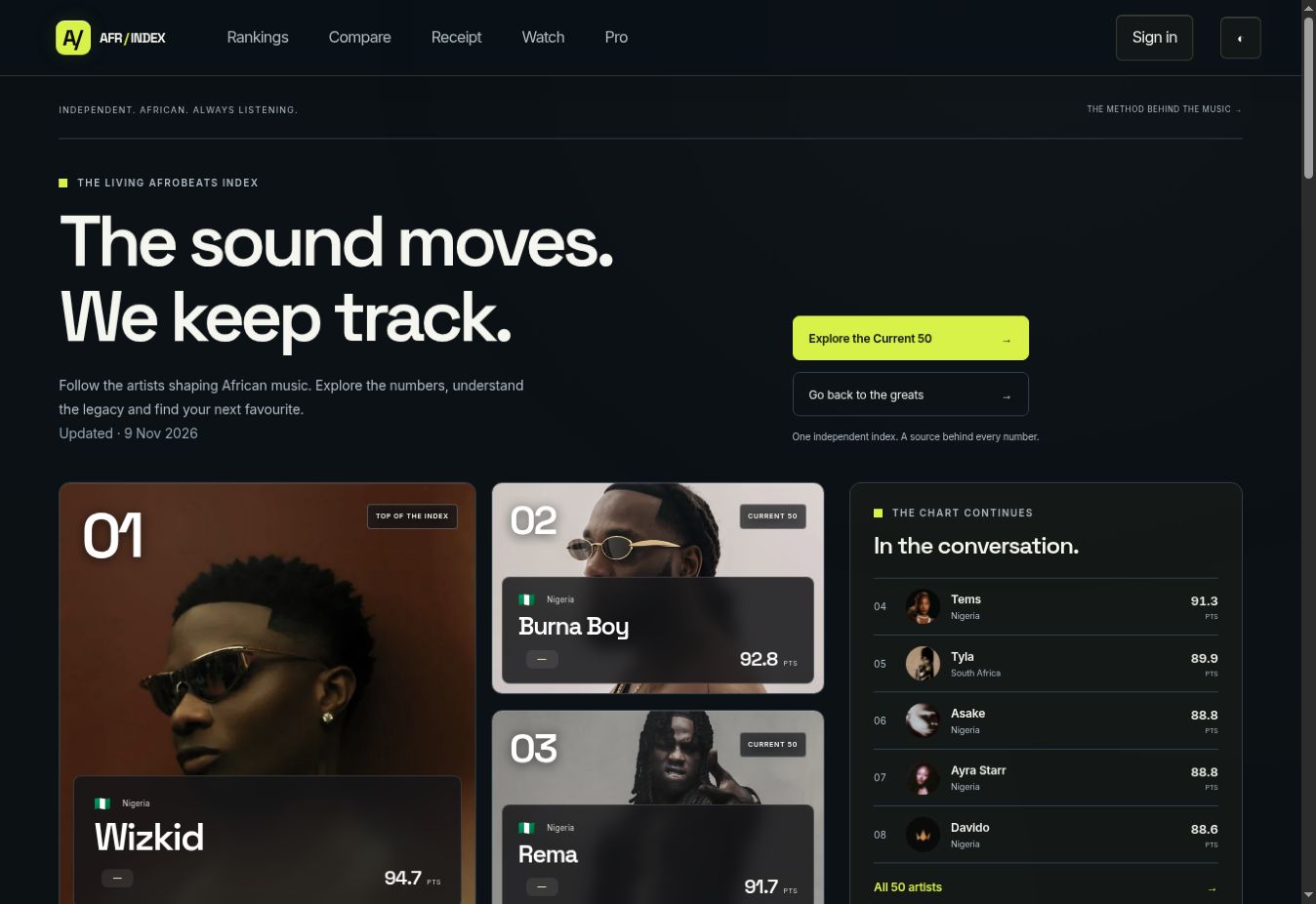
A sourced Afrobeats index that makes its rankings, artist records and methodology open to inspection.
The passion project
It Started With an Argument.
My university roommates didn’t agree that Omah Lay deserved a place in the Afrobeats top 10. I started gathering streaming statistics, rankings and achievements to back up my argument. Somewhere along the way, I fell in love with building the project itself.
“Of everything I've built, Afri Index is probably the project closest to my heart. What started as an argument became something I genuinely fell in love with building.”
Why does this exist?
Because apparently “just agree to disagree” wasn’t enough for me. But loving Omah Lay doesn’t mean quietly moving him up the rankings. The methodology has to be transparent and defensible.
Behind the build
What went into it.
Product design, frontend development & editorial data
Why it exists
Most Afrobeats rankings read like fan arguments with numbers added afterwards. I wanted to build one where the method is visible, the data has dates and sources, and disagreement can start with the actual weighting instead of hype.
Design & development
A dark editorial index with an All-Time 50, a researched Current 50, weekly rank movement, side-by-side era comparison, ten weighted Current metrics, and artist files covering biographies, verified Spotify totals, awards, touring history, FIFA/EA FC soundtrack placements, and official Gold, Platinum and Diamond certifications.
The difficult part
Ranking real named artists means every position has to be defensible. I had to keep streaming evidence useful without letting Spotify erase the achievements of artists whose biggest work predates it.
What I learned
Public music data is far messier than a polished chart suggests. Monthly audiences move daily, catalogue totals differ between trackers, and cross-era comparisons need qualitative context as much as platform numbers.
Where it stands
Turned a static ranking into a transparent living index with update history, sourced streaming signals, reliable artist imagery, official certification records, and a methodology readers can inspect.
A project that keeps evolving.
01The roommate argument
An opinion about Omah Lay became a question worth researching.
02The original idea
Gather evidence rather than just make a louder argument.
03Early data gathering
Streaming figures, rankings and achievements needed sources.
04First interface
Learning through tutorials, templates and layout experiments.
05Design improvements
Studying UI/UX and polishing the frontend one iteration at a time.
06Technical integrations
Working through APIs, Supabase, Resend, authentication and database infrastructure along the wider development journey.
07The current platform
A living index with an inspectable methodology; the current public build’s technologies are listed above.
08What comes next
More reliable data and further improvements as time and budget allow. This is still evolving, not a completed commercial platform.
Have something in mind?